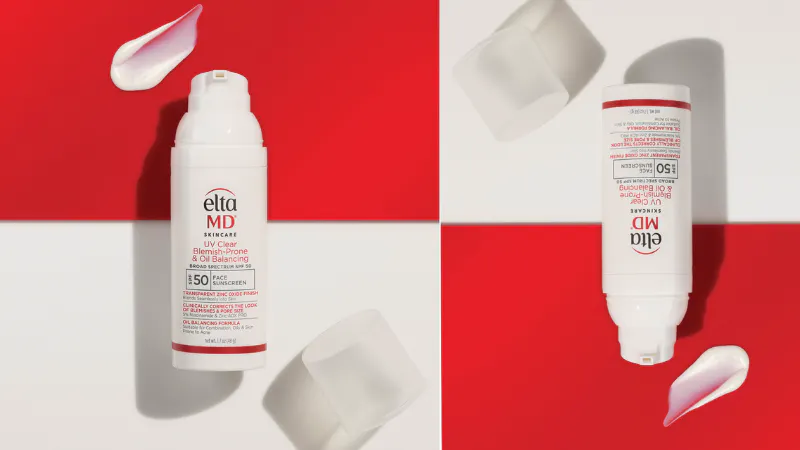
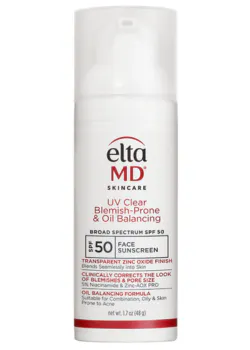
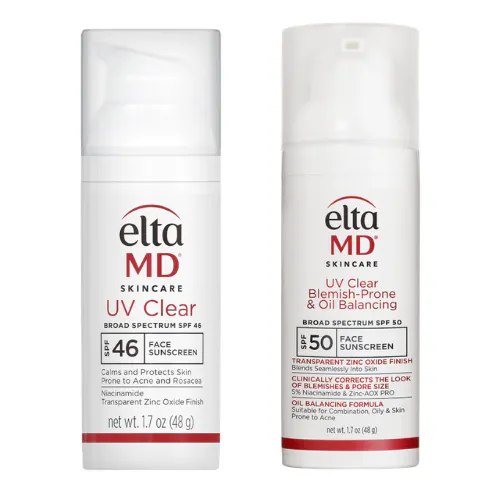
EltaMD UV Clear SPF 46 is one of the most searched-for sunscreens on SKINSKOOL. It's been a dermatologist go-to for acne-prone skin for years, and its zinc oxide + niacinamide formula has inspired a long list of products from other brands. So when EltaMD launched the UV Clear Blemish-Prone & Oil Balancing SPF 50, we pulled up both ingredient lists to see how it's different.
If you have acne-prone skin, you know the trade-off: sunscreen is non-negotiable, but most formulas either feel greasy, clog pores, or make breakouts worse. The original UV Clear earned its following by not making things worse. What EltaMD appears to be attempting with the new version is a shift from "doesn't hurt" to "actively helps."
Key Takeaways
- The new formula bumps SPF from 46 to 50, increases Zinc Oxide from 9% to 11%, and introduces EltaMD's proprietary ZincAOXPro technology, a four-antioxidant complex designed for broader environmental protection beyond just UV.
- New ingredients not found in the original UV Clear include Ethylhexyl Methoxycrylene (a photostabilizer), Carnosine, Pongamia Pinnata Seed Extract, Ginger Root Extract, and Bisabolol.
- In a 12-week clinical study on acne-prone skin, participants saw a 65% reduction in visible blemishes, 61% reduction in oil and shine, and 25% reduction in visible pore size.
- The original UV Clear was built to protect without aggravating breakouts. The new version appears to go a step further by actively targeting blemishes, oil, and pore size while protecting.
- It retails for $49 for 1.7oz, compared to $45 for the original UV Clear SPF 46.
What Stayed the Same
Let's start with the shared DNA, because there's plenty of it. Both formulas are built around the same core philosophy: zinc oxide-based protection combined with 5% niacinamide for blemish and oil control. Several key inactive ingredients carry over too.
5% Niacinamide (Vitamin B3) remains the star treatment active in both formulas. At this concentration, niacinamide has solid research backing its ability to help regulate oil production, reduce the appearance of blemishes, and improve overall skin tone. EltaMD kept this unchanged.
Zinc Oxide is the primary UV filter in both, though the new version bumps it from 9% to 11%. Zinc oxide is widely considered one of the gentlest broad-spectrum filters available, and it also has inherent anti-inflammatory properties that make it well-suited for reactive, breakout-prone skin.
Shared inactive ingredients include Octyldodecyl Neopentanoate, Hydroxyethyl Acrylate/Sodium Acryloyldimethyl Taurate Copolymer, Polyisobutene, PEG-7 Trimethylolpropane Coconut Ether, Sodium Hyaluronate, Tocopheryl Acetate, Lactic Acid, Oleth-3 Phosphate, Phenoxyethanol, and Triethoxycaprylylsilane. The backbone is familiar.
What's New in the Blemish-Prone Formula
This is where the new version starts to pull away from the original. Several ingredients appear in the Blemish-Prone formula that are completely absent from the original UV Clear SPF 46:
ZincAOXPro Technology is EltaMD's new proprietary antioxidant complex. EltaMD describes it as a blend of four antioxidants paired with zinc oxide. Based on the ingredient list, the four antioxidants appear to be Tocopheryl Acetate, Tocopherol, Carnosine, and Pongamia Pinnata Seed Extract, though EltaMD hasn't publicly confirmed the exact composition. The technology is designed to work against a broader range of environmental stressors. EltaMD claims it helps protect against not just UV rays, but also blue light, high-energy visible light (HEVL), smog, and diesel exhaust. Whether you work outdoors, commute through a city, or spend hours in front of screens, that multi-threat protection angle is increasingly relevant.
Carnosine is a naturally occurring dipeptide (two amino acids linked together) with antioxidant properties. It's been studied for its ability to help protect proteins from oxidative damage and glycation, both of which contribute to skin aging. It's not a common sunscreen ingredient, which makes its inclusion here noteworthy.
Pongamia Pinnata Seed Extract (also known as karanja) comes from a tree native to South and Southeast Asia. The seed extract has been used in traditional medicine and appears to offer natural UV-absorbing properties alongside antioxidant benefits. It seems to function as both a skin-conditioning agent and a UV booster in this formula.
Ethylhexyl Methoxycrylene is a newer UV stabilizer that helps other sunscreen filters maintain their effectiveness longer. It acts as a photostabilizer, which may help the formula deliver more consistent protection throughout the day.
Zingiber Officinale (Ginger) Root Extract is included for its soothing and anti-inflammatory properties. For acne-prone skin that's already dealing with redness and irritation, this appears to be a targeted addition.
Bisabolol, derived from chamomile, is another anti-inflammatory and skin-calming agent. It appears in the new version but not the original.
The formula also swaps in Dimethicone (a non-volatile silicone) in place of the original's Cyclopentasiloxane, and adds Butyloctyl Salicylate, an emollient that appears to enhance spreadability.
The SPF Bump: 46 to 50
The original UV Clear sits at SPF 46 with 9% Zinc Oxide and 7.5% Octinoxate. The new Blemish-Prone version goes to SPF 50 with 11% Zinc Oxide and 3.5% Octinoxate.
That's an interesting shift. More zinc oxide (11% vs 9%) means more mineral protection and potentially more of zinc's anti-inflammatory benefits on acne-prone skin. Less octinoxate (3.5% vs 7.5%) means less reliance on the chemical filter, which some people prefer to minimize. And the addition of Ethylhexyl Methoxycrylene as a photostabilizer may help compensate for the reduced octinoxate by keeping the overall protection more stable over time.
The net result is a higher SPF with a formula that leans more heavily on mineral protection. For acne-prone skin, that shift toward zinc appears deliberate.
The Clinical Results
EltaMD ran a 12-week clinical study with 43 subjects (ages 18-45, all Fitzpatrick types, with acne-prone, oily skin) using the product daily. The reported results at 12 weeks:
- 65% reduction in visible blemishes
- 61% reduction in excess oil and shine
- 25% reduction in visible pore size
Results reportedly began appearing as early as week 4, with progressive improvement through week 12. That four-week milestone is worth noting because it's early enough to keep someone motivated to stick with the product, and late enough that the changes are likely reflecting real skin improvement rather than just a temporary cosmetic effect. Worth noting that this is a single brand-funded study, so independent replication would strengthen the claims. But the data is specific, the study population is relevant, and the methodology (daily use, photos not retouched) appears straightforward.
For a sunscreen to claim it actively improves acne rather than just not making it worse, that's a higher bar. Most acne-friendly sunscreens just promise to be non-comedogenic. This one is claiming to be part of the treatment.
How Does It Compare to the Original UV Clear?
If you're already using and loving the original UV Clear SPF 46, the new Blemish-Prone version isn't necessarily a replacement. They're positioned differently:
The original UV Clear SPF 46 ($45) is a broader product for sensitive, acne-prone, and rosacea-prone skin. It's lighter on active treatment ingredients beyond niacinamide and relies on a simpler, well-proven formula.
The new Blemish-Prone & Oil Balancing SPF 50 ($49) is specifically targeting oily, actively breakout-prone skin with a more complex formula. The ZincAOXPro technology, the additional anti-inflammatory botanicals (ginger root, bisabolol), and the clinical study focused on blemish reduction all point to a product that's trying to do more than just protect.
If your skin is acne-prone and oily, and you want your sunscreen pulling double duty on blemish control, the new version appears to be the more targeted choice. If your skin is more sensitive or rosacea-prone without significant oiliness, the original UV Clear may still be the better fit.
One thing both products share is a focus on wearability. The new Blemish-Prone formula is lightweight, absorbs quickly, and is designed to sit comfortably under makeup without pilling or leaving a greasy film. For anyone who's ever skipped reapplication because their sunscreen felt like too much on their skin, that matters. EltaMD appears to have designed this so that wearing SPF daily doesn't feel like a compromise, and for acne-prone skin specifically, a product you'll actually reapply is a product that works.
What About Alternatives?
The original UV Clear's formula has been widely emulated: zinc oxide, octinoxate, niacinamide, hyaluronic acid, clean base. Plenty of brands have echoed that approach. The new Blemish-Prone version is a harder act to follow. The ZincAOXPro technology is proprietary, the specific combination of carnosine, pongamia pinnata, ginger root, and bisabolol alongside niacinamide and zinc oxide isn't something we've seen elsewhere, and the clinical blemish-reduction data adds a layer that competitor products haven't matched yet.
The Bottom Line
This is a significant departure from the original UV Clear formula. Higher SPF, more zinc oxide, a proprietary antioxidant complex, targeted anti-inflammatory botanicals, clinical data showing measurable blemish improvement over 12 weeks, and a lightweight texture designed for comfortable daily reapplication. That's a lot of jobs for one product: UV protection, environmental defense, blemish correction, oil control, pore refinement, and wearability.
At $49 for 1.7oz, it's only $4 more than the original UV Clear. For someone with oily, acne-prone skin who's been treating sunscreen as a necessary evil rather than an active part of their routine, this appears to be EltaMD's attempt to change that relationship.
Whether the clinical results hold up across a wider population remains to be seen. But based on the ingredient list and the study data, the formulation intent is clear: a sunscreen that does more than just protect.
The EltaMD UV Clear Blemish-Prone & Oil Balancing SPF 50 is available now at EltaMD.com and authorized retailers for $49.