Key Takeaways
- One supplier ingredient, many names. At least seven hair mask brands — including Filament Sciences, Verb, Not Your Mother's, Moroccanoil, Holy Curls, Andrew Fitzsimons, and isima — appear to use the same bond-repair ingredient from a single supplier: Ashland's FiberHance BM.
- The price spread is staggering. That same core technology costs $0.046/mL in Not Your Mother's Curl Talk Bond Building Mask ($10.99) and $0.16/mL in Filament's TS.02/Tt ($48) — a 3.5x difference for what appears to be the same active bond-repair engine.
- Proprietary names hide shared origins. Filament calls it TENSILYX™. isima calls it GluconaBond™. Andrew Fitzsimons calls it their AF BONDING SYSTEM™. Different trademarks, but the INCI tells a different story.
- Your INCI list never lies. In our database of 50,000+ products, hydroxypropylgluconamide and hydroxypropylammonium gluconate always appear as a pair — never one without the other — consistent with every brand sourcing the same pre-made ingredient rather than formulating with these molecules independently.
- The $48 mask does have something unusual. Filament's formula includes polycitronellol acetate, a rare ingredient that doesn't appear in any other hair mask in our database. But that ingredient gets little attention in the marketing compared to TENSILYX™.
The Violet Grey Launch That Started Our Deep Dive
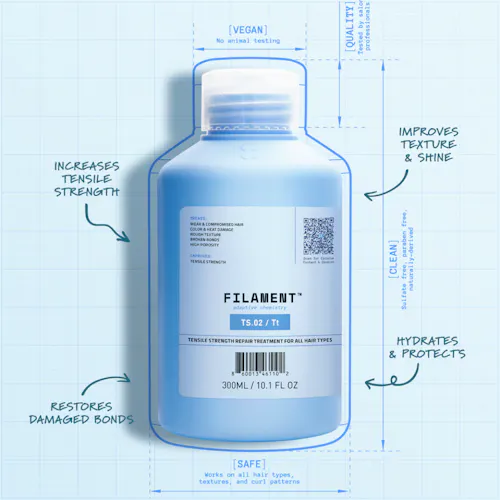
Filament Sciences recently launched its TS.02/Tt Tensile Strength Hair Treatment Mask as a Violet Grey exclusive, and the beauty world noticed. It sold out within about a week and a half, generating a wait list hundreds long. Violet Grey gave it the full editorial treatment — Violet Code Approved status, endorsements from trichologists and hairstylists, plus a dedicated feature in The Violet Files.
The marketing was compelling: "proprietary technology called TENSILYX™," "patented long-chain molecules," "adaptive chemistry," and claims of increasing tensile strength by 3x. At $48 for 300mL, it positioned itself as clinical-grade treatment backed by real science.
We wanted to know: what's actually behind TENSILYX™?
Reverse-Engineering TENSILYX™
Filament describes TENSILYX™ as containing "patented long-chain molecules," "essential fatty acids," "polyphenols," and "antioxidants." When we mapped these claims against the INCI list, here's what we found:
"Patented long-chain molecules" likely maps to hydroxypropylgluconamide and hydroxypropylammonium gluconate — two ingredients that appear to correspond to Ashland's FiberHance BM, a commercially available bond-repair solution that won gold at in-cosmetics 2017. The underlying chemistry is covered by a US patent filed by Hercules LLC, an Ashland subsidiary.
It may also refer to polycitronellol acetate, a terpene-derived polymer that appears to come from P2 Science's Citropol product line — but Filament hasn't publicly clarified the composition of TENSILYX™, so we're working from the INCI list and publicly available supplier information.
"Essential fatty acids" — the oil and butter blend: coconut, abyssinian seed, avocado, sunflower, shea butter, murumuru butter, plus ethyl linoleate and ethyl oleate.
"Antioxidants" — tocopherol (vitamin E) and a synthetic stabiliser.
"Polyphenols" — the weakest link. There's no dedicated polyphenol ingredient in the INCI. This claim likely relies on trace amounts naturally present in the plant oils.
In other words, TENSILYX™ appears to be a proprietary name for a carefully chosen combination of commercially available ingredients — not a novel molecule created in-house.
One Ingredient, Seven Brands
Here's where it gets interesting. When we searched our database for the same hydroxypropylgluconamide & hydroxypropylammonium gluconate pair, we found it across a wide range of brands — each marketing it under a different proprietary name:
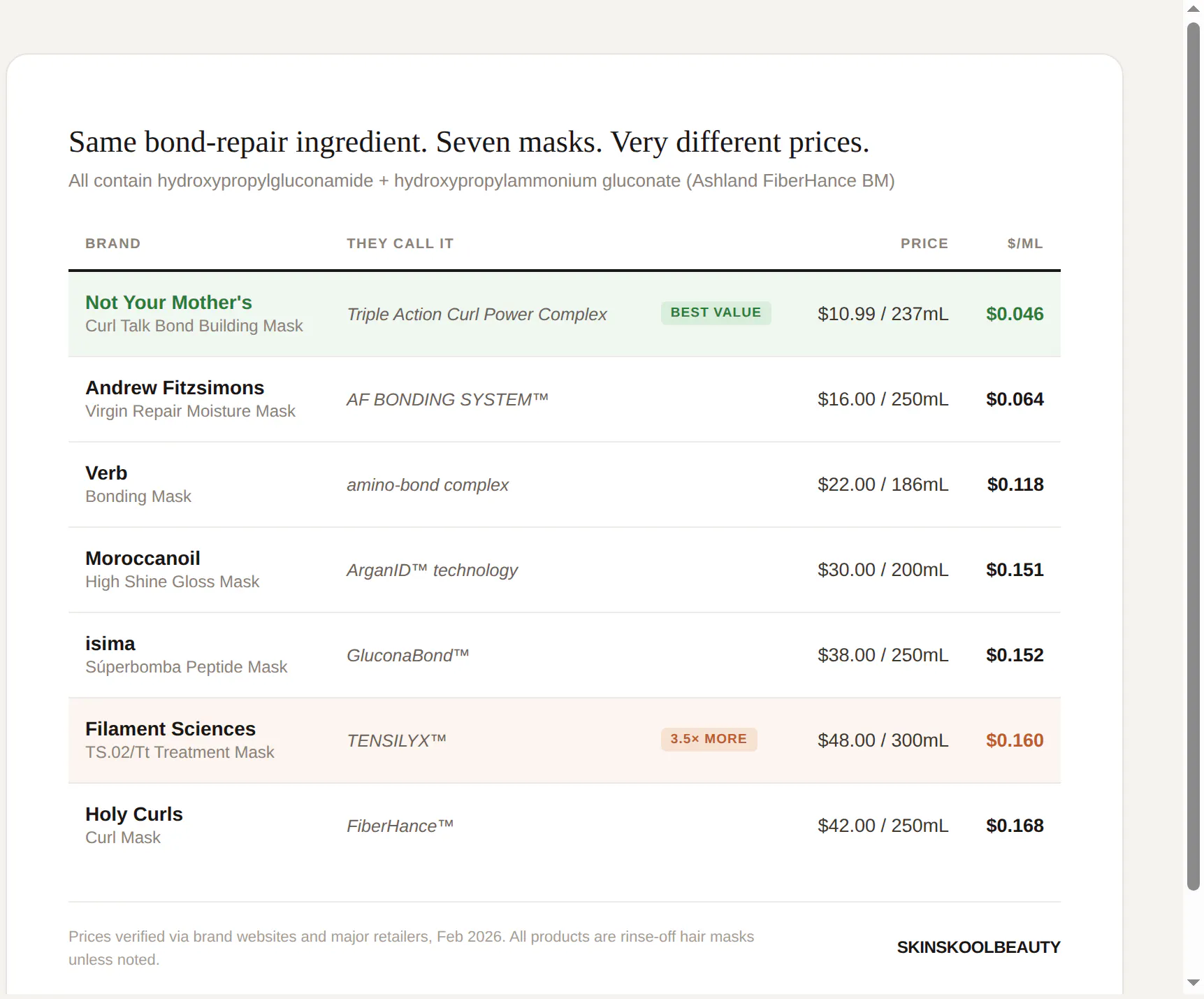
We can't say with absolute certainty that every brand sources from Ashland — only the manufacturers know their supply chains. But all the evidence we've found points in that direction: the INCI names match Ashland's product exactly, the two molecules always appear as a pair (consistent with Ashland's pre-made solution), the patent is held by an Ashland subsidiary, and we haven't been able to identify any alternative supplier manufacturing this combination. Holy Curls even references the FiberHance name directly in its marketing.
It's also worth noting that Ashland's own technical brochure describes FiberHance BM as penetrating "deep into the cortex" to create "new hydrogen and ionic bonds within the keratin structure" providing "up to 3x strengthening" — language that closely mirrors how several of these brands describe their own proprietary technologies. Even Moroccanoil — which bundles the ingredient under its broader ArganID™ branding — includes the same pair alongside its signature argan oil and amino acid blend.
So What Are You Actually Paying For?
If the bond-repair core appears to be the same, are these products interchangeable? Not exactly.
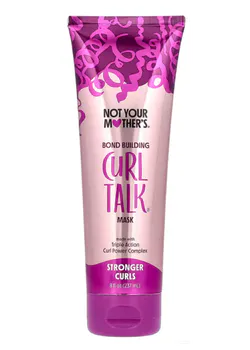
Not Your Mother's ($10.99/237mL) (also at Ulta) wraps the bond-repair technology in a clean, silicone-free formula with hydrogenated castor oil, rice amino acids, avocado oil, and marula oil. It's straightforward and effective. It's branded for the curly hair community ("Curl Talk"), but there's nothing curl-specific about bond repair — damaged straight hair benefits from the same mechanism. If bond repair is your primary goal, this represents remarkable value.
Filament ($48/300mL) delivers what appears to be the same bond-repair engine, but in a more complex formula. The standout is polycitronellol acetate — an ingredient that doesn't appear in any other hair mask across our 50,000-product database. Based on publicly available information from its likely manufacturer (P2 Science), it's a terpene-derived polymer designed as a sustainable silicone alternative, with published data showing strong performance in conditioning and breakage reduction.
Whether polycitronellol acetate is the reason Filament chose it, or whether it serves a different function in their formula, we can't say for certain. But its rarity is notable — and somewhat ironic, given that the marketing spotlight falls almost entirely on TENSILYX™ and bond repair rather than this genuinely unusual ingredient. "Silicone Free" appears as a small badge at the bottom of the product page.
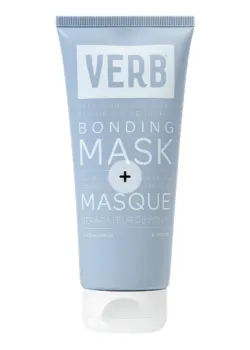
Verb ($22/186mL) is an interesting middle ground. It contains the same Ashland ingredient pair plus what appears to be a second bond-repair technology (bis-4-PCA dimethicone, likely Grant Industries' Granrepair PowerBond) that targets disulfide bonds specifically. It also uses conventional silicones for conditioning. Arguably the most technically loaded formula in this group, yet its "amino-bond complex" marketing undersells it compared to Filament's science-forward branding.
Not All "Bond Repair" Is the Same
The bond-repair trend in haircare exploded after Olaplex popularised the concept around 2014-2015. Since then, the word "bond" has become marketing gold. But these products don't all work the same way:
Disulfide bond repair (Olaplex, K18): targets the strongest hair bonds — covalent bonds broken by chemical processing like bleaching.
Hydrogen and ionic bond repair (Ashland's FiberHance BM, found across all seven products we examined): creates new hydrogen and ionic bonds within the keratin structure. These are weaker than disulfide bonds but still structurally meaningful — they're the bonds disrupted by heat styling, water, and mechanical stress.
Both approaches have science behind them. But when a brand says "bond repair," it's worth asking: which bonds, and how?
What This Means for You
- The bond-repair mechanism in a $48 mask and a $10.99 mask can be the same. If strengthening damaged hair is your primary goal, the price premium may not be buying you better bond repair.
- Premium pricing often reflects the supporting cast — conditioning agents, sensory experience, oil blends, brand positioning — not a fundamentally different active technology.
- "Proprietary complex" is a branding exercise. When you see a trademarked ingredient name, check the INCI list. The actual ingredients are required by law to be disclosed.
- Don't let marketing categories limit your choices. Not Your Mother's targets the curly community, but its bond-repair formula works on any damaged hair. A straight-haired person scrolling past "Curl Talk" could be missing an effective, affordable option.
- Always check the INCI. That's what we're here for at SKINSKOOL.